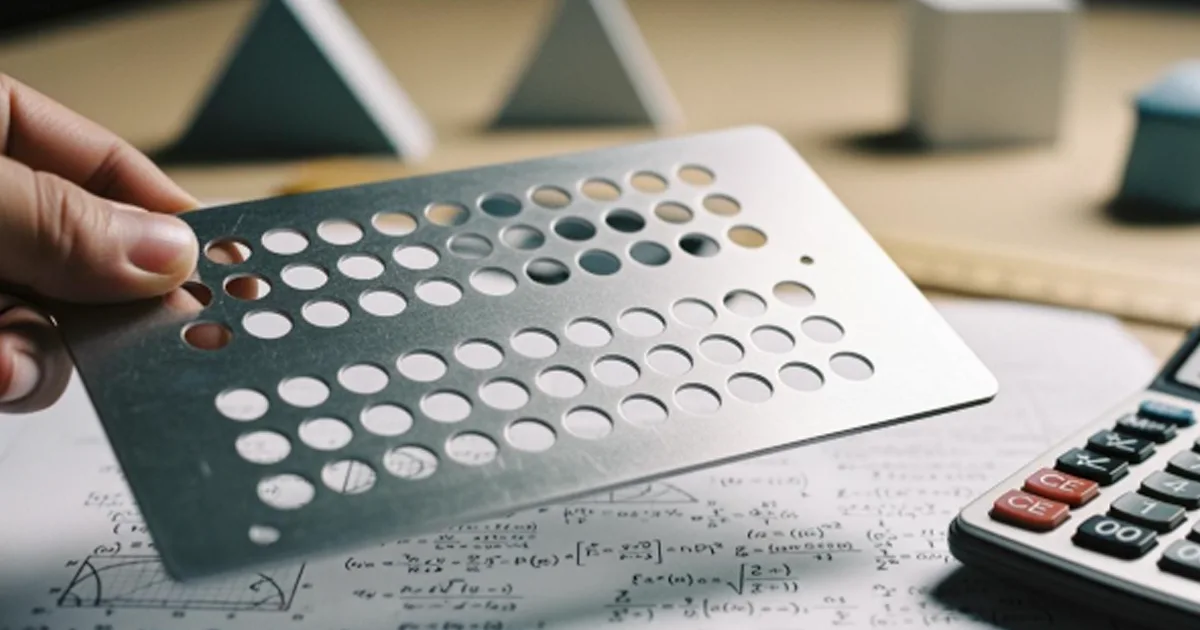
To perform a perforated plate open area calculation, you need to divide the total area of all the holes by the area of the entire plate. Afterward, multiply the result by 100 to convert it into a percentage. This percentage is crucial as it indicates how much air, light, or liquid can pass through. Achieving the correct open area is essential for optimal airflow, effective filtering, or an appealing design. Conducting a perforated plate open area calculation ensures you achieve the best outcome for your project.
Key Takeaways
- To find open area, divide hole area by plate area, then times by 100.
- Open area percentage tells how much of the plate has holes, which changes airflow and strength.
- More open area lets in more air and light but makes the plate weaker.
- Use special formulas for different hole patterns like round, square, or hexagonal.
- Measure hole size and pitch carefully to get good results.
- Look at manufacturer data for standard plates to save time.
- Do not mix up pitch and hole size or you might make mistakes.
- Use a ruler or caliper to measure things exactly.
What Is Open Area Percentage
Definition and Significance
When you look at a perforated plate, you might wonder how much of it is actually open space. The open area percentage tells you exactly that. It shows what part of the sheet is made up of holes instead of solid metal. For example, if a plate has an open area of 40%, that means 40% of the surface is holes and 60% is metal. You can think of it as a ratio that helps you see how much of the plate lets air, light, or liquid pass through.
Tip: If you see a panel with small holes and tight spacing, the open area percentage will be lower. If the holes are bigger or closer together, the open area percentage goes up.
This number matters a lot. It helps you decide if a plate will work for your project. If you need more airflow or light, you want a higher open area. If you need strength and security, you might choose a lower open area. The open area percentage gives you a quick way to compare different plates and pick the right one.
Here’s a quick look at what different open area percentages mean for your project:
- High Open Area (50-70%): Great for letting air, light, or sound through. You’ll see this in things like HVAC systems, sunshades, or acoustic panels.
- Low Open Area (10-30%): Better for strength and safety. People use these for fencing, enclosures, or protective covers.
- Balance is key: More open area means less strength. You need to find the right mix for your needs.
How Open Area Affects Performance
The open area percentage changes how a perforated plate works. If you want more air to move through, you need a higher open area. This helps with ventilation and cooling. It also makes filtration better because more particles can pass through the holes. On the other hand, a lower open area slows down airflow and can make filtration less effective.
You’ll see open area percentage used in many places. Here’s a table that shows where it matters most:
| Application Type | Description |
|---|---|
| Acoustic Control | Uses small holes and tight spacing to help with sound. |
| Ventilation | Needs the right open area to keep air moving well. |
| Lighting | Lets light through while keeping the plate strong. |
When you do a perforated plate open area calculation, you make sure your plate will do its job. You get the right mix of airflow, strength, and looks for your project.
Perforated Plate Open Area Calculation: General Formula
When you want to figure out how much of your perforated plate is open, you need a simple formula. This formula helps you see how much air, light, or liquid can pass through your sheet. Let’s break it down step by step so you can do a perforated plate open area calculation with confidence.
Universal Formula Overview
The universal formula for open area percentage looks like this:
Open Area (%) = (Total Area of Holes / Total Area of Plate) × 100
You can use this formula for any shape or pattern. But most plates use round or square holes, so there are special formulas for those. Here’s a quick table that shows the most common formulas and the variables you’ll see:
| Perforation Pattern | Mathematical Formula (%OA) | Key Variables |
|---|---|---|
| Round (60° Staggered) | (D² × 90.69) / C² | D = Diameter; C = Center Pitch |
| Round (90° Straight) | (D² × 78.54) / C² | D = Diameter; C = Center Pitch |
| Square (Straight/Staggered) | (S² × 100) / C² | S = Side Length; C = Center Pitch |
Note: The open area percentage tells you what part of the plate is made up of holes. This number is very important for airflow and strength. If you want more air to pass through, you need a higher open area. If you want more strength, you need a lower open area.
Variable Definitions
Let’s look at what each variable means. You’ll see these in the formulas above:
- D: This is the diameter of each round hole. You measure it from one side of the hole to the other, straight across the middle.
- S: This is the side length of each square hole. Just measure one edge of the square.
- C: This is the center-to-center distance between holes. You measure from the center of one hole to the center of the next hole. People also call this the “pitch.”
Here’s a table to help you remember:
| Variable | What It Means | How to Measure |
|---|---|---|
| D | Diameter of round hole | Across the center of the hole |
| S | Side length of square hole | Along one edge of the square |
| C | Center-to-center distance (pitch) | From center of one hole to next |
If you use the wrong measurement for pitch or hole size, your perforated plate open area calculation will not be correct. Always double-check your numbers!
Step-by-Step Example
Let’s walk through a simple example together. Imagine you have a metal plate with round holes in a straight pattern. Each hole has a diameter (D) of 5 mm. The center-to-center pitch (C) is 8 mm.
Here’s how you do the math:
- Write down the formula for round holes in a straight pattern:
Open Area (%) = (D² × 78.54) / C² - Plug in your numbers:
- D = 5 mm
- C = 8 mm
- Calculate D squared:
- 5 × 5 = 25
- Calculate C squared:
- 8 × 8 = 64
- Multiply D squared by 78.54:
- 25 × 78.54 = 1,963.5
- Divide by C squared:
- 1,963.5 ÷ 64 = 30.68
So, your open area percentage is about 30.7%.
Tip: If you want more airflow, try using bigger holes or placing them closer together. But remember, more open area means less strength. Always check with your manufacturer if you need your plate to hold weight or stay strong.
A perforated plate open area calculation helps you balance airflow and strength. If you want a plate that lets in lots of air, you need a higher open area. If you need your plate to be strong, you might want a lower open area. Always measure carefully and use the right formula for your pattern.
Round Holes: Open Area Formulas
When you work with perforated plates, round holes are the most common choice. They give you great airflow and look clean. You can arrange these holes in different patterns. Each pattern changes how much open area you get. Let’s break down the main types and see how you can calculate the open area for each one.
Straight Pitch (Square Pattern)
Formula and Variables
In a straight pitch, the holes line up in rows and columns, just like squares on a chessboard. This pattern is simple and easy to measure.
The formula for open area percentage in this pattern is:
Open Area (%) = (D² × 78.54) / C²
- D is the diameter of each round hole.
- C is the center-to-center distance between holes (pitch).
Tip: Always measure from the center of one hole to the center of the next. This keeps your calculation accurate.
Example Calculation
Let’s say your holes are 6 mm wide (D = 6 mm) and the pitch is 10 mm (C = 10 mm).
- Square the diameter: 6 × 6 = 36
- Square the pitch: 10 × 10 = 100
- Multiply the diameter squared by 78.54: 36 × 78.54 = 2,827.44
- Divide by the pitch squared: 2,827.44 ÷ 100 = 28.27
So, your open area is about 28.3%.
60-Degree Staggered Pitch
Formula and Variables
This pattern looks like a honeycomb. The holes are staggered, so each row sits in the gap of the row above. This setup lets you fit more holes in the same space, which means more open area.
The formula for this pattern is:
Open Area (%) = (D² × 90.69) / C²
- D is the diameter of the hole.
- C is the center-to-center pitch.
Note: The 60-degree staggered pattern gives you the highest open area for round holes.
Example Calculation
Suppose your holes are 4 mm wide (D = 4 mm) and the pitch is 7 mm (C = 7 mm).
- Square the diameter: 4 × 4 = 16
- Square the pitch: 7 × 7 = 49
- Multiply the diameter squared by 90.69: 16 × 90.69 = 1,451.04
- Divide by the pitch squared: 1,451.04 ÷ 49 = 29.61
Your open area is about 29.6%.
45-Degree Staggered Pitch
Formula and Variables
In this pattern, the holes are staggered at a 45-degree angle. It’s less common but still useful for some designs.
The formula is:
Open Area (%) = (D² × 79.6) / C²
- D is the diameter of the hole.
- C is the pitch.
Example Calculation
If your holes are 5 mm wide (D = 5 mm) and the pitch is 8 mm (C = 8 mm):
- Square the diameter: 5 × 5 = 25
- Square the pitch: 8 × 8 = 64
- Multiply the diameter squared by 79.6: 25 × 79.6 = 1,990
- Divide by the pitch squared: 1,990 ÷ 64 = 31.09
So, your open area is about 31.1%.
Why choose round holes?
Here’s a quick table to help you compare round holes with other shapes:
| Hole Shape | Advantages | Disadvantages |
|---|---|---|
| Round | Maximum ventilation and acoustic performance; great for HVAC use. | May not be as strong as square holes. |
| Square | Strong and tough; fits modern designs. | Less airflow than round holes. |
| Slotted | Good for directional flow and special looks. | Not as strong as square holes. |
If you want the best airflow, round holes in a staggered pattern are your top pick. When you do a perforated plate open area calculation, always check your pattern and measurements. This helps you get the right balance of strength and ventilation for your project.
Square Holes: Open Area Calculation
Square holes give you a modern look and strong structure. You see them in fences, screens, and even some speaker covers. If you want to know how much open space you get with square holes, you need to use the right formula. Let’s break it down for both straight and staggered patterns.
Straight Pitch
Formula and Variables
In a straight pitch, the square holes line up in neat rows and columns. It looks like a grid or a checkerboard. This pattern is easy to measure and calculate.
Here’s the formula you’ll use:
Open Area (%) = (S² × 100) / C²
- S stands for the side length of each square hole.
- C is the center-to-center distance between holes (the pitch).
Tip: Always measure from the center of one hole to the center of the next. This keeps your numbers accurate.
Example Calculation
Let’s try an example. Imagine each square hole is 8 mm wide (S = 8 mm), and the pitch is 12 mm (C = 12 mm).
- Square the side length: 8 × 8 = 64
- Square the pitch: 12 × 12 = 144
- Multiply the side squared by 100: 64 × 100 = 6,400
- Divide by the pitch squared: 6,400 ÷ 144 ≈ 44.44
So, your open area is about 44.4%. That means almost half of your plate is open space!
Staggered Pitch
Formula and Variables
A staggered pitch means the holes in one row sit between the holes in the next row. This pattern lets you fit more holes in the same space. You get more open area without losing strength.
The formula for staggered square holes looks like this:
Open Area (%) = (S² × 100) / (C × R)
- S is the side of the square hole.
- C is the horizontal center-to-center pitch.
- R is the vertical center-to-center pitch.
Note: Measure both the horizontal and vertical pitch. They might not be the same!
Example Calculation
Let’s say your square holes are 6 mm wide (S = 6 mm). The horizontal pitch is 10 mm (C = 10 mm), and the vertical pitch is 8 mm (R = 8 mm).
- Square the side: 6 × 6 = 36
- Multiply the pitches: 10 × 8 = 80
- Multiply the side squared by 100: 36 × 100 = 3,600
- Divide by the pitch product: 3,600 ÷ 80 = 45
Your open area is 45%. That’s a lot of space for air, light, or water to pass through.
If you want to make a quick perforated plate open area calculation, always check your pattern and measure carefully. The right formula gives you the best results for your project.
| Pattern Type | Formula | When to Use |
|---|---|---|
| Straight Pitch | (S² × 100) / C² | Grid or checkerboard look |
| Staggered Pitch | (S² × 100) / (C × R) | Offset rows for more open area |
Now you know how to handle square holes. Try these formulas on your next project and see how much open area you can get!
Slotted Holes: Open Area Calculation
Slotted holes look like little rectangles or ovals cut into your plate. You see these in screens, guards, and even some speaker covers. They let air or water flow in one direction more than the other. You can arrange slotted holes in two main ways: parallel or staggered. Let’s see how you can calculate the open area for each style.
Parallel Arrangement
Formula and Variables
In a parallel arrangement, all the slots line up in straight rows and columns. This pattern is easy to measure and works well for simple designs.
Here’s the formula you’ll use:
Open Area (%) = (W × L × 100) / (P × R)
- W: Width of the slot (the narrow side)
- L: Length of the slot (the long side)
- P: Pitch between slots (center-to-center distance along the row)
- R: Row pitch (center-to-center distance between rows)
Tip: Always measure from the center of one slot to the center of the next. This keeps your calculation accurate.
Example Calculation
Let’s try an example. Suppose each slot is 3 mm wide (W = 3 mm) and 20 mm long (L = 20 mm). The pitch along the row is 8 mm (P = 8 mm), and the row pitch is 25 mm (R = 25 mm).
- Multiply width by length: 3 × 20 = 60
- Multiply the pitches: 8 × 25 = 200
- Multiply the slot area by 100: 60 × 100 = 6,000
- Divide by the pitch product: 6,000 ÷ 200 = 30
So, your open area is 30%.
Note: If you want more open area, try making the slots longer or placing them closer together. Just remember, more open area means less strength.
Staggered Arrangement
Formula and Variables
In a staggered arrangement, each row of slots sits in the gap between the slots above and below. This pattern lets you fit more slots in the same space. You get more open area without losing too much strength.
The formula looks like this:
Open Area (%) = (W × L × 100) / (P × R)
- W: Slot width
- L: Slot length
- P: Pitch along the row
- R: Row pitch
Tip: The formula is the same as the parallel pattern, but the way you measure the pitches might change. Always check your plate to see if the rows are offset.
Example Calculation
Let’s say your slots are 2 mm wide (W = 2 mm) and 15 mm long (L = 15 mm). The pitch along the row is 6 mm (P = 6 mm), and the row pitch is 18 mm (R = 18 mm).
- Multiply width by length: 2 × 15 = 30
- Multiply the pitches: 6 × 18 = 108
- Multiply the slot area by 100: 30 × 100 = 3,000
- Divide by the pitch product: 3,000 ÷ 108 ≈ 27.78
Your open area is about 27.8%.
Quick Check: Always double-check your measurements. If you mix up the pitch or slot size, your open area calculation will be off.
Here’s a quick table to help you remember:
| Arrangement | Formula | When to Use |
|---|---|---|
| Parallel | (W × L × 100) / (P × R) | Straight rows and columns |
| Staggered | (W × L × 100) / (P × R) | Offset rows for more open area |
Now you know how to handle slotted holes. Try these formulas on your next project and see how much open area you can get!
Hexagonal and Special Patterns
Hexagonal Holes Formula
Hexagonal holes look like honeycombs. You see them in speaker grilles, sunshades, and even some building facades. This pattern gives you a lot of open space and a cool modern look. If you want to figure out the open area for hexagonal holes, you need a special formula.
Formula and Variables
Here’s the formula you can use for hexagonal holes:
Open Area (%) = (A_hole × N) / A_total × 100
- A_hole: Area of one hexagonal hole.
- N: Number of holes in the measured area.
- A_total: Total area of the measured plate.
To find the area of one hexagonal hole, use this formula:
A_hole = (3 × √3 × a²) / 2
- a: Length of one side of the hexagon.
Tip: Always measure the side of the hexagon, not the distance across the flats.
Example Calculation
Let’s say each hexagonal hole has a side length (a) of 5 mm. You count 100 holes in a plate that measures 100 cm².
- Find the area of one hole:
- A_hole = (3 × 1.732 × 25) / 2 = (3 × 1.732 × 25) / 2
- 3 × 1.732 = 5.196
- 5.196 × 25 = 129.9
- 129.9 / 2 = 64.95 mm²
- Multiply by the number of holes:
- 64.95 mm² × 100 = 6,495 mm²
- Convert the plate area to mm²:
- 100 cm² = 10,000 mm²
- Divide and multiply by 100:
- (6,495 / 10,000) × 100 = 64.95%
So, your open area is about 65%. That’s a lot of space for air or light!
Note: Hexagonal patterns give you more open area than square or round holes in most cases.
Other Patterns Overview
You might see other special patterns in perforated plates. These designs can make your project stand out or fit a unique need. Here are some examples you might find:
- Round perforations in a straight pattern
- Round perforations in a staggered pattern
- Square perforations, like those on the Haas Moto Museum’s facade
- Diamond-shaped perforations in metal panels
- Rectangular perforations, such as in Zahner ImageLines panels
Each pattern changes how the plate looks and works. Some let in more air, while others add strength or style.
When you want to calculate the open area for a custom pattern, you need to add up the area of all the holes. Then, divide that total by the visible surface area of the plate. Multiply by 100 to get the percentage. Every pattern needs its own calculation because the arrangement and shape of the holes matter.
Quick Tip: For custom designs, sketch your pattern and measure each hole. Add up all the open spaces. Divide by the total plate area. This method works for any shape—hexagons, diamonds, rectangles, or even custom logos.
If you want a special look or need a certain amount of airflow, try a unique pattern. Just remember to check your math so your plate works the way you want!
Measurement Tips and Common Mistakes
Measuring Hole Size and Pitch
Getting the right measurements is the first step to a good open area calculation. If you measure wrong, your results will be off. You want your plate to work well, so let’s talk about how to measure holes and pitch the right way.
- Always measure the diameter for round holes. For square holes, measure straight across the center lines.
- Use a ruler or caliper for the most accurate results.
- Pick a straight line on your plate that is at least 150 mm long. Make sure you include at least eight holes in a row. This helps you spot any mistakes or odd holes.
- Do the same in the other direction. This means you check both rows and columns.
- If you see a hole that is too big or too small, check if it fits the tolerance for your project. If one hole is way off, the plate might not be good to use.
- If your plate is small and doesn’t have eight holes in a row, check every hole.
- Take your measurements on the punch side of the plate. This is the side where the holes look the cleanest.
Tip: You can follow standards like ISO 7805-1 or ISO 7805-2. These standards help you measure the right way, based on how thick your plate is.
Avoiding Calculation Errors
You want your numbers to be right. Small mistakes can lead to big problems later. Here are some things to watch out for:
- Don’t mix up the pitch and the hole size. Pitch is the distance from the center of one hole to the center of the next.
- Always use the same units. If you measure in millimeters, keep everything in millimeters.
- Double-check your math. It’s easy to square the wrong number or forget to multiply by 100.
- Watch out for patterns. Make sure you use the right formula for your hole arrangement—straight, staggered, or special.
- If you’re not sure, measure again. It’s better to spend a few extra minutes than to order the wrong plate.
Alert: If you use the wrong formula or mix up your measurements, your open area percentage will not match the real plate.
Using Manufacturer Data
Sometimes, you don’t have to measure everything yourself. Manufacturers often provide open area percentages and other details for their standard plates. You can find this information in catalogs or on their websites.
- Check the product sheet for hole size, pitch, and open area percentage.
- Compare your measurements with the manufacturer’s numbers. If they match, you can trust the data.
- If you need a custom plate, ask the manufacturer for help. They can run the calculations for you.
- Use manufacturer data to save time and avoid mistakes.
Note: Manufacturer data is helpful, but always double-check if you’re working on a special project or need exact numbers.
By following these tips, you’ll get accurate measurements and avoid common mistakes. This means your perforated plate will work just the way you want.
Conclusion
You can calculate the open area of a perforated plate in just a few steps:
- Pick your hole pattern—round, square, slotted, or hexagonal.
- Measure the hole size and pitch.
- Use the right formula for your pattern.
Accurate measurements make your results reliable. Small mistakes can change how your plate works. If you need a custom solution, we can help you design the perfect plate for your project. Reach out for expert advice or special fabrication needs!
FAQ
What is the open area percentage in a perforated plate?
Open area percentage tells you how much of the plate is holes. To find it, divide the area of all the holes by the area of the whole plate. Then, multiply your answer by 100.
Why does open area matter for my project?
Open area changes how much air or light can go through. If you want more air or light, pick a plate with a higher open area. If you need the plate to be stronger, choose a lower open area.
How do I measure the pitch on a perforated metal sheet?
To measure pitch, start at the center of one hole. Measure to the center of the next hole. Use a ruler or caliper for the best results. Check a few rows to make sure your measurements are right.
Can I use these formulas for any hole shape?
The general formula works for any hole shape. For round, square, slotted, or hexagonal holes, use the special formulas in this guide. If your pattern is different, you might need a custom calculation.
What tools help me measure hole size and pitch?
You can use a ruler, measuring tape, or caliper. A caliper is best for small holes because it is very accurate. Always check your numbers twice before you start your calculation.
Where can I find open area data for standard plates?
Manufacturers usually show open area percentages in their catalogs or on their websites. If you need a special plate, ask the manufacturer to help you with the calculation.